Taking care of your vascular access in haemodialysis
Your vascular access is your lifeline for dialysis. Whether through an arteriovenous fistula or a central venous catheter, taking proper care of it is essential to ensure effective treatment and prevent complications. Discover the best practices for maintaining and protecting your vascular access.
Understanding your vascular access
There are two main types of vascular access used in haemodialysis:
1/ Arteriovenous fistula (AVF): the preferred option
The arteriovenous fistula is the recommended vascular access for haemodialysis, as it offers the best long-term durability and the lowest risk of infection. It is created surgically by connecting an artery to a vein, usually in the arm.
Why choose a fistula?
The artery-to-vein connection increases blood flow within the vein, making it larger and stronger.
This allows repeated needle insertions and ensures sufficient blood flow for effective dialysis.
A well-maintained fistula can last for many years.
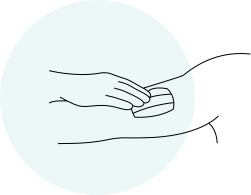
Maturation time After the procedure, the fistula generally takes between 1 and 3 months to develop before it can be used for dialysis. During this period, you may be advised to perform exercises (such as squeezing a foam ball) to help it mature properly.
2/ Central venous catheter: a temporary but higher-risk solution
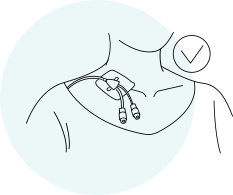
A central venous catheter is a flexible tube inserted into a large vein, usually in the neck (jugular vein) or below the collarbone (subclavian vein). It is used in emergencies or when the fistula is not yet ready for use.
Advantages
It can be used immediately, without any maturation period.
It is often used while waiting for a fistula to be created and mature.
Disadvantages and Risks
Higher risk of infection, as it is an external device.
Increased risk of thrombosis (blood clots).
It can be fragile and may restrict certain movements.
Good habits to help protect your fistula
Monitor your fistula every day
Check for a “thrill” or vibration under your fingers. This indicates that blood is flowing properly.
Make sure the skin around the fistula is clean and free from redness, swelling or pain.
If bleeding continues after dialysis, apply pressure with a sterile dressing and contact your healthcare team if the bleeding persists.
Adopt protective habits in everyday life
Do not wear watches, bracelets or tight clothing on the arm with the fistula.
Avoid blood pressure measurements and injections in that arm.
Protect your arm from knocks and injuries (DIY activities, gardening, sports, etc.).
Stimulate your fistula to improve its effectiveness
After surgery, perform regular exercises such as squeezing a foam ball to help the vein develop.
Taking care of a central venous catheter
Essential hygiene and precautions
Do not touch the catheter entry site with unwashed hands
Always keep the dressing clean and dry. It should only be changed with the assistance of a healthcare professional.
Avoid pulling or twisting the catheter with clothing or sudden movement.
During dialysis connection and disconnection procedures, ensure that both you and your nurse wear a mask to reduce the risk of infection.
When should you seek medical advice?
Contact your healthcare team if you notice:
No vibration or thrill in the fistula, which may indicate a blockage.
Redness, swelling, pain or unusual warmth around your vascular access.
Persistent bleeding after a dialysis session.
Fever or unexplained discomfort, which may indicate a catheter infection
A well-maintained vascular access is essential for effective dialysis and improved day-to-day comfort. By adopting these simple habits, you can reduce the risk of complications and extend the lifespan of your access. If you have any concerns or questions, do not hesitate to speak with your healthcare team.
Vous êtes sur le point de quitter le site de Physidia France
Vous avez cliqué sur un lien conduisant hors du site Physidia France. Votre navigation sur cet autre site est soumise à ses propres conditions générales et de confidentialité. IL est possible que les produits de cet autre site ne soient pas disponibles à la vente dans votre région ou votre pays.
You clicked on a link leading outside the Physidia France site. Your browsing on this other site is subject to its own general and confidentiality conditions. The products on this other site may not be available for sale in your region or country.






 Home » What is HHD? »